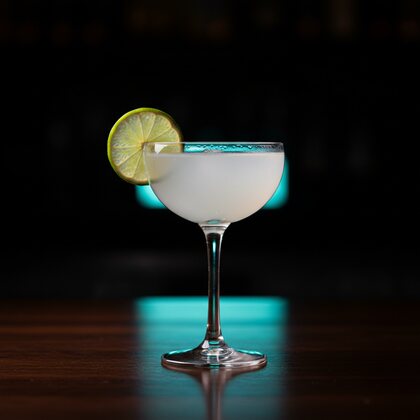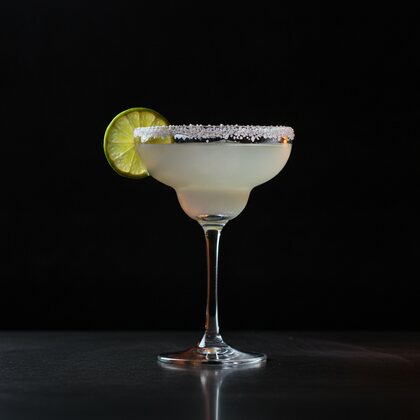
Margarita
The Margarita is the best selling tequila cocktail in the world and the one hotel bars get wrong most often. It is a sour: spirit, orange liqueur and fresh lime, shaken hard and served up in a chilled coupe or over ice with half a rim of salt. Nothing in it is difficult, which is why it exposes lazy habits: bottled lime juice, a mixto tequila, salt caked inside the rim, a five second shake with wet ice, and the guest gets a sweet, flat drink. Done properly it is bright and cold, sharp lime first, agave and pepper underneath, a whisper of orange and a clean salty edge. In a hotel bar it sells from lunch to last call, so every bartender must produce the same glass to the millilitre.
Specification
| Ingredients | Amount | Role in the glass |
|---|---|---|
| Blanco tequila, 100% agave | 50 ml | The whole point of the drink. Unaged 100% agave gives cooked agave, pepper and citrus. A mixto (51% agave plus sugar spirit) tastes thin and hot |
| Triple sec style orange liqueur | 20 ml | Sweetness and orange lift. At 30 to 40% ABV it also adds strength, which is why the IBA spec feels spirit forward |
| Freshly squeezed lime juice | 15 ml | Acid and aroma. Pressed within 4 hours of service. Bottled juice is oxidised and bitter |
| Ice for shaking | 4 to 5 dry cubes of about 3 cm | Chills to around -5 °C and dilutes by about 25%. Small or wet ice over dilutes before the drink is cold |
| Flaky sea salt for the rim | A 5 mm band on half the outside rim, optional | Salt suppresses bitterness and brightens lime and agave. Outside only, so it never falls into the drink |
| Lime wheel or wedge | 1 piece | Signals freshness and lets the guest add acid to taste |
Technique
- Put the coupe or rocks glass in the freezer at -18 °C for at least 10 minutes, or fill it with ice and water while you workA shaken sour arrives at about -5 °C. A warm glass steals 3 to 4 degrees in the first minute
- Salt the rim first: run a lime wedge around the outside of half the rim in a 5 mm band, then roll that outside edge through flaky salt on a tilted plate. Wipe any grains off the insideSalt inside the rim dissolves into the drink and over seasons it by the third sip. A half rim lets the guest choose a salted or clean side
- Press limes at room temperature within 4 hours of service, strain out the pulp and taste the juice each shiftCold limes give up to 20% less juice. Lime acidity swings between about 5 and 7% from batch to batch, so adjust by 5 ml rather than guess
- Jigger 50 ml blanco tequila, 20 ml orange liqueur and 15 ml lime juice into the small tin, then fill the large tin with 4 to 5 dry cubes and sealLiquid first, ice last, so nothing melts while you pour. The IBA ratio is 10:4:3 and a 5 ml slip in the liqueur changes the balance
- Shake hard for 12 to 15 seconds until frost forms on the tin, driving the ice end to endA citrus drink needs a violent shake to chill, dilute and aerate at once. 12 to 15 seconds reaches about -5 °C and 25% dilution. Shorter is warm and harsh, longer is watery
- Double strain through a Hawthorne and a fine mesh strainer into the chilled coupe, or over fresh ice in the rocks glass. Add the lime wheel and serve at onceThe fine strainer catches ice shards and pulp that would cloud and keep diluting the drink. Never serve on the shaking ice
Service
Origin
Nobody can prove who made the first Margarita. What can be shown is the family it belongs to: the Daisy, a 19th century American sour of spirit, liqueur and citrus, and Margarita is simply Spanish for daisy. A Tequila Daisy was known on the border before any famous claimant. On 23 July 1936 the Moville Mail, a small Iowa newspaper, printed editor James Graham's account of Tijuana, where Irish bartender Henry Madden's Turf Bar advertised the Home of the Famous Tequila Daisy, invented, he said, by grabbing the wrong bottle. In 1937 the Café Royal Cocktail Book in London, compiled by W. J. Tarling, printed the Picador: tequila, orange liqueur and lime in a 2:1:1 ratio, a Margarita in all but name and salt rim. Then come the disputed origin stories. Carlos Danny Herrera said he built it in 1938 at Rancho La Gloria near Tijuana for the actress Marjorie King. Hussong's Cantina in Ensenada credits Don Carlos Orozco in 1941, naming it for Margarita Henkel. Francisco Pancho Morales claimed 4 July 1942 at Tommy's Place in Ciudad Juárez. Margarita Sames, a Dallas socialite, said she mixed it for guests in Acapulco in 1948. The first printed recipe called Margarita appeared in Esquire in December 1953 as Drink of the Month: an ounce of tequila, a dash of triple sec and the juice of half a lime or lemon. Newspaper research now traces tequila sours on the Texas border to the 1920s, so the drink most likely evolved in many hands. On 11 May 1971 Mariano Martinez converted a soft serve machine in his Dallas restaurant into the first frozen Margarita machine, acquired by the Smithsonian in 2005. In 1990 Julio Bermejo at Tommy's Mexican Restaurant in San Francisco swapped the orange liqueur for agave nectar; the International Bartenders Association lists Tommy's Margarita among its New Era Drinks and the classic in the Contemporary Classics at 50/20/15.
Taste and body
The nose is fresh lime and a sweet, vegetal agave note with a touch of orange. The first sip is bright acid and cold, then the tequila fills the middle with cooked agave, white pepper and a faint green olive character. The orange liqueur sits underneath as roundness rather than obvious sweetness. The finish is medium, clean and slightly saline from the salted side. Body is light to medium with a silky texture from the shake. A correct Margarita is pale straw and very slightly hazy from the lime, never bright green or cloudy with pulp.
Pairs well with
- Guacamole and warm tortilla chips
- Ceviche or fresh oysters with lime
- Tacos al pastor and other grilled pork tacos
- Grilled prawns or whole fish with chilli and lime
- Queso fundido, nachos and melted cheese dishes
- Hot chicken wings and other spicy fried food, the acid and salt reset the palate
Hotel bar variations
- Tommy's Margarita · Julio Bermejo, Tommy's Mexican Restaurant, San Francisco, 1990. The orange liqueur is dropped for agave nectar, so it tastes purely of tequila and lime. IBA New Era Drink, served on the rocks with a lime slice. Use agave syrup diluted 1:1 with water
- Frozen Margarita · Blended with about 150 g of ice per drink to a smooth slush. On 11 May 1971 Mariano Martinez in Dallas built the first frozen Margarita machine from a soft serve unit, now in the Smithsonian. Add 5 ml more sweetener because cold dulls sweetness
- Spicy Margarita (Jalapeño Margarita) · Muddle 2 to 3 thin jalapeño slices, seeds removed, in the tin before shaking, or infuse the blanco tequila with jalapeño for 30 to 60 minutes, tasting every 15. Rim with chilli salt. The most requested modern twist in hotel bars
- Cadillac Margarita · A reposado Margarita finished with a 10 to 15 ml float of brandy based orange liqueur poured over the back of a bar spoon. Origin disputed between a Nuevo Laredo bar and 1980s Southern California. Richer, usually on the rocks
- Mezcal Margarita · Blanco tequila replaced by mezcal, or split 25/25, for smoke and roasted agave. Same ratio, same shake, chilli salt rim. For guests who already know the classic
Common mistakes
- Sour mix or bottled lime juice. The drink turns sweet, flat and slightly bitter. Fresh lime pressed within 4 hours is not optional
- Mixto tequila instead of 100% agave. Thin, hot and sugary, and no technique will hide it
- Salt inside the rim, or a full rim of fine iodised salt. It dissolves into the drink and the guest has no clean side
- A short shake with small or wet ice. The drink arrives at 2 to 3 °C instead of -5 °C, tastes harsh and warms fast
- Pouring the liqueur by eye and never tasting the limes. A Margarita lives on a 5 ml margin; one heavy hand and it is a dessert
Bartender's notes
Write the house spec on a card behind the bar, because the Margarita is the drink guests compare between hotels. The IBA 50/20/15 is spirit forward and suits guests who love tequila; many hotel bars run a softer 50/25/20, or 50/20/20 with 10 ml of agave syrup, which reads as fresher at lunch. Taste your limes each shift and move the juice by 5 ml either way. For pool parties and events of 100 or more, batch tequila and orange liqueur at the exact ratio, refrigerate, add fresh lime only within 4 hours of service and shake each drink to order; never batch lime overnight. Keep a spicy version and a Tommy's on the menu: the three cover almost every guest.
Let the AI bartender pick the right one for you
One photo. The AI reads your mood and chooses from all 20 classics.
Frequently asked questions
What is the official IBA Margarita recipe?
50 ml tequila 100% agave, 20 ml triple sec and 15 ml freshly squeezed lime juice. Shake with ice and strain into a chilled cocktail glass. Half salt rim, marked optional. Listed in the Contemporary Classics.
Why must the tequila be 100% agave?
Tequila labelled only tequila may be a mixto, 51% agave sugars and 49% other sugars, which tastes thin and hot. 100% agave blanco gives the cooked agave, pepper and citrus that carry the drink. Check the label for 100% agave.
Is the salt rim compulsory?
No. The IBA lists it as optional and hotel bars always ask. Salt softens bitterness and brightens lime and agave. Apply it to the outside of half the rim only, so the guest has a clean side and no salt falls into the drink.
Up or on the rocks?
The IBA serves it up in a chilled cocktail glass, the cleanest way to show the shake. On the rocks over one large fresh cube stays cold longer in a hot climate. Both are correct; ask the guest.
How strong is a Margarita?
The IBA spec is about 22 to 24% ABV after shaking dilution, close to a Negroni. Cold and acid make it drink lighter than it is, which is why hotel bars serve water alongside.
What is a Tommy's Margarita?
A version by Julio Bermejo at Tommy's Mexican Restaurant in San Francisco, 1990, that replaces the orange liqueur with agave nectar so the drink tastes purely of tequila and lime. The IBA lists it among its New Era Drinks, served on the rocks.
Who invented the Margarita?
Nobody can prove it. Claims include Carlos Herrera near Tijuana in 1938, Hussong's Cantina in Ensenada in 1941, Pancho Morales in Ciudad Juárez in 1942 and Margarita Sames in Acapulco in 1948. A Tequila Daisy was reported in Tijuana in 1936 and the identical Picador was printed in London in 1937, so the drink most likely evolved in many hands.
What is the difference between a Margarita and a Paloma?
Both are tequila and lime, but the Paloma is a long drink: tequila, lime and grapefruit soda built over ice in a highball, often with a salt rim. Lighter, fizzy and about half the strength, and in Mexico the more common everyday tequila drink.