Dry Martini
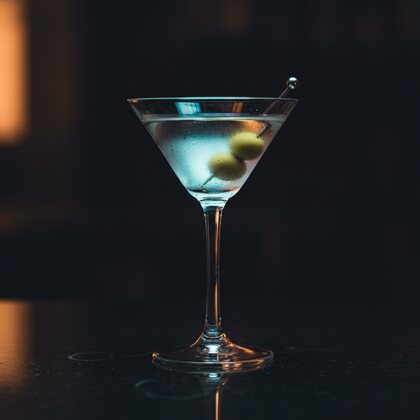
The Dry Martini is the drink a hotel bar is judged by. Two ingredients, no citrus, no sugar, served without ice, so there is nowhere for a fault to hide: a glass that was not frozen, vermouth open on the shelf since last month, a stir that stopped 10 seconds early. It is also the drink guests have the most opinions about. One wants it bone dry with a twist, the next wet and dirty with three olives, and both expect you to know what those words mean. Done right it arrives at about -5 °C, water clear, oily on the tongue and sharp with juniper, with a sheet of lemon oil across the surface.
Specification
| Ingredients | Amount | Role in the glass |
|---|---|---|
| London dry gin | 60 ml | Almost the whole drink, so its quality is the drink's quality. Juniper, citrus peel and coriander carry the aroma, 40% or more ABV carries the texture |
| Dry vermouth | 10 ml | Seasoning rather than a partner. A touch of wine acidity, herbs and a little sugar that rounds the gin. Refrigerate after opening, use within 4 weeks |
| Ice for stirring | Mixing glass three quarters full of 3 cm cubes, meltwater tipped out | Chills the drink to about -5 °C and supplies the 20 to 25% dilution that makes 70 ml of spirit drinkable |
| Lemon peel | 1 strip, about 2 by 5 cm, pith trimmed | The IBA garnish. Expressed oil on the surface is the first aroma the guest meets and lifts the citrus already in the gin |
| Green olives | 1 or 3 on a pick, only if requested | The IBA alternative garnish. Salt and brine turn the drink savoury. Rinse off packing brine unless the guest asked for it dirty |
Technique
- Put the cocktail glass in the freezer at -18 °C for at least 30 minutes. Keep 6 in there through serviceA drink served without ice has nothing to keep it cold. A 22 °C glass warms 90 ml of liquid by about 4 °C in the first minute
- Fill a mixing glass three quarters full with 3 cm cubes straight from the freezer, tip out any meltwaterWet ice has already begun to melt and dilutes before you stir. Dry, hard ice lets you control exactly how much water goes in
- Jigger 10 ml dry vermouth first, then 60 ml gin, into the mixing glassThe cheaper ingredient goes in first so a mistake costs 10 ml of vermouth, not 60 ml of gin. At 6 to 1 a 5 ml slip halves the ratio, so measure every time
- Stir with a bar spoon along the inside wall, smooth and silent, 30 to 45 turns, about 30 seconds, until the outside of the mixing glass frostsStirring brings the drink to around -5 °C and adds 20 to 25% water. Both are needed: 70 ml of 40% spirit is undrinkable undiluted, and below -3 °C gin turns silky instead of hot. Shaking is faster but leaves cloudiness, ice shards and air that dull the texture
- Take the glass from the freezer, strain with a julep strainer held tight against the ice, pour in one motion to 1 cm below the rimA frozen glass fogs white the moment it meets air, which the guest reads as cold before tasting. One motion keeps ice chips out
- Express the lemon peel oil side down about 5 cm above the surface, wipe the rim, drop it in. If the guest asked for olives, add them on a pick insteadThe IBA spec is lemon oil first, olives on request. Never both unless asked. The oil sits on the surface and reaches the nose before the gin reaches the tongue
Service
Origin
The origin of the Martini is disputed, and any bar that claims to have invented it is telling a story rather than citing a record. The documented ancestor is the Martinez. O. H. Byron's The Modern Bartender's Guide of 1884 describes it as a Manhattan with gin in place of whiskey, and the 1887 edition of Jerry Thomas's Bar-Tender's Guide prints a Martinez of Old Tom gin, sweet vermouth, maraschino and bitters. Two rival legends attach to it, the Occidental Hotel in San Francisco and a saloon in the town of Martinez, California, and neither can be verified. The first recipe printed as Martini Cocktail is generally credited to Harry Johnson's Bartenders' Manual of 1888, and it is sweet: Old Tom gin and Italian vermouth in equal parts with bitters and curaçao. The dry version arrived in the early 1900s as London dry gin and French dry vermouth came into fashion. William Boothby's The World's Drinks and How to Mix Them of 1907 gives what is probably the earliest recipe titled Dry Martini Cocktail, with gin, dry French vermouth, lemon peel and an olive. The often repeated claim that Martini di Arma di Taggia created it at the Knickerbocker Hotel in New York around 1911 for John D. Rockefeller postdates the printed record and is treated by historians as legend. The ratio then dried out decade by decade: 2 to 1 by 1922, 3 to 1 in the 1930s, 4 to 1 in the 1940s, 5 or 6 to 1 after the Second World War, which is where the IBA spec of 60 ml to 10 ml sits today. Ian Fleming's Casino Royale of 1953 added the Vesper, gin, vodka and a quinine aromatised wine, shaken very well until ice cold. The phrase shaken, not stirred first appears in the novel Diamonds Are Forever in 1956, and Bond first says it on screen in Goldfinger in 1964. The IBA lists the Dry Martini among The Unforgettables.
Taste and body
Cold hits before flavour. Then juniper, a pine and citrus sharpness, with the vermouth showing as a faint wine acidity and herb note underneath. Texture is the point: at -5 °C with 20 to 25% dilution the gin turns thick and almost oily on the tongue instead of burning. Lemon oil across the surface gives a bright nose that lasts the whole glass. Dry, clean finish of 20 to 30 seconds. The liquid must be perfectly clear. Haze or floating ice means it was shaken or strained loosely.
Pairs well with
- Green olives, ideally 3 kinds of different saltiness
- Oysters on ice with lemon, the drink's dryness mirrors the brine
- Smoked salmon or gravlax on rye
- Salted almonds and cashews
- Caviar or salmon roe on blinis
- Hard aged cheese such as Comté or aged Gouda
Hotel bar variations
- Vesper · Ian Fleming's drink from Casino Royale in 1953: gin, vodka and a quinine aromatised wine, shaken very well until ice cold, lemon peel. IBA official recipe: 45 ml gin, 15 ml vodka, 7.5 ml aromatised wine, shaken. Fleming credited his friend Ivar Bryce with mixing the first one
- Dirty Martini · A Dry Martini with 5 to 15 ml of olive brine in the mixing glass and olives as garnish. Its ancestor is a Martini with muddled olives served at the Waldorf Astoria in New York in 1901, and a printed recipe using brine appears by 1931. Salty, cloudy and savoury, always ask how dirty
- Gibson · The same drink garnished with a pickled cocktail onion. Origin disputed between a Bohemian Club member in San Francisco in the 1890s and the illustrator Charles Dana Gibson in New York. The first printed recipe with an onion is Boothby's of 1908
- Vodka Martini (Kangaroo) · Gin replaced by 60 ml vodka. Printed as the Kangaroo Kicker in Oscar Haimo's Cocktail Digest of 1943, shortened to Kangaroo the next year. Cleaner and softer with no juniper, the most requested Martini in many hotel bars
- Martinez · The 1880s ancestor. Old Tom gin, sweet red vermouth, a dash of maraschino and aromatic bitters, stirred, lemon peel. Sweet, spiced and closer to a Manhattan. Worth offering to a guest who finds the Dry Martini too austere
Common mistakes
- A glass that was not frozen. Nothing else matters if the drink lands in a 22 °C glass, it is warm within a minute
- Vermouth open on the back bar for months. It is wine, it oxidises, and it turns the drink flat and stale. Refrigerate after opening and finish within 4 weeks
- Stirring for 10 seconds and serving. The drink is still at 2 to 3 °C with too little dilution, so it tastes hot and thin. Stir until the mixing glass frosts, about 30 seconds
- Shaking a gin Martini by default. Cloudy, ice shards, over diluted. Shake only if the guest asks, and confirm it back to them
- Serving without asking. Twist or olive, dry or wet, gin or vodka. Guessing wrong on a Martini is the fastest way to lose a regular
Bartender's notes
Learn the vocabulary, because guests use it as a test. Dry means less vermouth, extra dry means a rinse or a few drops, wet means 20 ml or more. Fifty-fifty is equal parts. Dirty means olive brine, perfect means half dry and half sweet vermouth, with a twist means lemon peel, on the rocks means over ice in an Old Fashioned glass. Repeat the order back in those words. Keep a bottle of gin in the freezer at -18 °C beside the glasses. It will not freeze, and starting cold means you reach -5 °C with fewer turns and less dilution, which is what a guest who asks for it very cold and very dry actually wants. Glassware matters: the V shaped Martini glass looks classic but spills easily and warms fast. A Nick & Nora glass of 140 to 170 ml holds temperature better and is easier to carry across a room, which is why most serious hotel bars have moved to it. Never fill above 1 cm from the rim.
Let the AI bartender pick the right one for you
One photo. The AI reads your mood and chooses from all 20 classics.
Frequently asked questions
What is the official IBA Dry Martini recipe?
60 ml gin and 10 ml dry vermouth, stirred well with ice cubes in a mixing glass and strained into a chilled Martini cocktail glass. Garnish by squeezing the oil from a lemon peel onto the drink, or with green olives if requested. The IBA lists it under The Unforgettables.
How strong is a Dry Martini?
Very strong. After stirring it sits at roughly 30% ABV, higher than a Negroni and close to a Manhattan. It is 70 ml of neat spirit plus water with nothing to soften it, which is why hotel bars serve it with water and a bite to eat.
Shaken or stirred?
Stirred. A drink made only of spirits and fortified wine is stirred so it stays clear and silky. Shaking clouds it with air and ice shards. James Bond's order is a film line, not bar technique. If a guest asks for it shaken, shake it and serve it with a smile.
What does dry mean in a Dry Martini?
The amount of dry vermouth, not the taste of the gin. The less vermouth, the drier the Martini. The IBA spec is 6 parts gin to 1 part vermouth. Extra dry means a rinse or a few drops, wet means 20 ml or more.
Why is the Martini glass shaped like a V?
The wide cone shows off the clear liquid and gives the lemon oil a large surface. Its drawbacks are spilling and fast warming, which is why many hotel bars now use a smaller Nick & Nora glass of 140 to 170 ml.
What is a Vesper?
The Martini James Bond orders in Casino Royale in 1953: gin, vodka and a quinine aromatised wine, shaken very well and served with a large thin slice of lemon peel. The IBA official recipe uses 45 ml gin, 15 ml vodka and 7.5 ml aromatised wine, shaken.
Who invented the Dry Martini?
Nobody can prove it. The ancestor is the Martinez, printed in 1884 and 1887. The first Martini Cocktail in print is Harry Johnson's of 1888, and it was sweet. The earliest printed Dry Martini is probably Boothby's of 1907. The Knickerbocker Hotel story of around 1911 is legend rather than record.
How long does open dry vermouth keep?
It is fortified wine, so once opened it oxidises. Keep it in the refrigerator with the cap tight and use it within 4 weeks. Vermouth left open on the back bar is the most common reason a Martini tastes flat and stale.