Old Fashioned
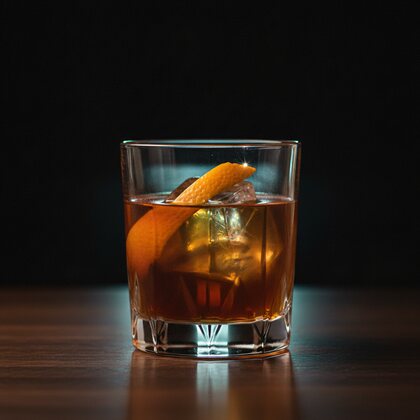
The Old Fashioned is the closest thing on a menu to the word cocktail in its original sense. Four ingredients, exactly as defined in 1806: spirit, sugar, water and bitters. Nothing hides the work: the whiskey is exposed, undissolved sugar heaps at the bottom, small ice turns the glass watery by the third sip. Done right it is clear amber, orange oil on the nose, just enough sweetness to coat the tongue, a long warm finish, and a flavour that keeps changing over the 20 minutes a large cube takes to melt.
Specification
| Ingredients | Amount | Role in the glass |
|---|---|---|
| Bourbon or rye whiskey | 45 ml per the IBA (modern hotel bars commonly pour 60 ml) | Bourbon gives vanilla and caramel from new oak, rye gives spice and dryness |
| Sugar cube | 1 cube (about 4 g), or 5 to 10 ml of 2:1 rich simple syrup | Rounds the heat of the whiskey and adds a little viscosity. Syrup dissolves instantly and measures more accurately |
| Aromatic bitters | 2 to 3 dashes | Spice, bark and a thread of bitterness that binds whiskey and sugar. Without them this is sweetened whiskey |
| Still water | 2 to 3 dashes (only when using a sugar cube) | Helps the sugar dissolve while muddling; sugar barely dissolves in 40% alcohol |
| Ice | One large clear 5 cm cube | Chills and dilutes slowly. The drink moves from intense to soft over 20 minutes, which is its charm |
| Orange peel and cocktail cherry | 1 strip of peel about 2 by 5 cm, 1 cherry (per the IBA) | Orange oil on the surface is the first aroma the guest meets. The cherry is the IBA garnish, optional in modern bars |
Technique
- Drop one sugar cube into an Old Fashioned glass, soak it with 2 to 3 dashes of bitters, then add 2 to 3 dashes of waterBitters soaked into the cube spread evenly through the drink. The water matters because sugar dissolves far better in water than in alcohol; without it you muddle a minute and still have grains
- Muddle with the flat end of a muddler, pressing and twisting 15 to 20 seconds until no grains are visible. With 2:1 rich simple syrup, measure 5 to 10 ml with a jigger and skip this stepUndissolved sugar sinks under the ice, so the first sip is dry and the last is syrup. Most hotel bars use syrup for consistency and keep the cube for guests who want to watch
- Pour 45 ml of whiskey per the IBA, or 60 ml per the modern hotel bar spec, always jiggered, and give it 5 quick turns to marry syrup and whiskey before the ice goes inMixing before the ice stops the sugar settling under the cube. 60 ml is popular because the drink sits on ice a long time and needs whiskey enough to survive the dilution; warn the guest it is a strong pour
- Add one large clear 5 cm cube, tipping out meltwater firstThe IBA says fill the glass with ice, but one large cube has far less surface area and melts about 3 times slower, so the whiskey still reads at minute 20. Tube ice flattens it in 5 minutes
- Stir with a bar spoon hugging the glass, 20 to 30 turns, about 20 to 25 seconds, until the outside of the glass is cold and wetStirring brings the drink to about -2 to 0 °C and dilutes it 15 to 20%, the water that makes a 40 to 50% whiskey taste round. Under stir and it burns, over stir and it tastes thin
- Express the orange peel oil side down about 5 cm above the drink until you see the oils land, wipe the rim, drop it in. For the full IBA garnish add one cocktail cherryOrange oil reaches the nose before the whiskey reaches the tongue, and orange flatters the vanilla in bourbon and the spice in the bitters. Expressing the peel in front of the guest is the moment they remember
Service
Origin
The root of this drink is the first printed definition of the word cocktail, in The Balance and Columbian Repository of Hudson, New York, on 13 May 1806. Editor Harry Croswell told a reader that a cocktail was a stimulating liquor of spirits of any kind, sugar, water and bitters. Through the 1860s and 1870s bartenders began adding curaçao, maraschino and absinthe, and drinkers who wanted none of it asked for theirs the old fashioned way, until the request became the name. The phrase old fashioned cocktails appears in the Chicago Daily Tribune in February 1880. The earliest known printed recipe is in Theodore Proulx's Bartender's Manual, Chicago, 1888, and George Kappeler's 1895 recipe, a small lump of sugar dissolved in a little water, two dashes of bitters, ice, lemon peel and a jigger of whiskey, is almost the modern IBA spec. The story that a Pendennis Club bartender in Louisville, Kentucky created it for bourbon distiller James E. Pepper, who carried it to New York, comes from Albert Stevens Crockett's 1931 book Old Waldorf Bar Days, and even he hedged with said to have been. The claim is disputed: the club was founded in 1881, a year after the name was in print, and its own bartenders Jacques Straub (1913) and Tom Bullock (1917) never claimed it in their books. After Prohibition, around 1930, orange slices and cherries entered the glass, and by the 1990s muddled fruit topped with soda was standard in ordinary bars. The craft cocktail movement of the 2000s took it back to 1806, spirit, sugar, bitters, a large cube and an orange peel, with the series Mad Men pushing it back into fashion. The IBA lists it among The Unforgettables.
Taste and body
Orange oil first on the nose, then vanilla and caramel from bourbon or pepper and dry spice from rye. The first sip is barely sweet, just enough to coat the tongue, before the whiskey arrives in full with a warmth that runs down the throat. Bitters sit behind with clove, cinnamon and bark. Full body, slightly viscous from the sugar, a finish of 40 seconds or more. Few cocktails taste as different at minute one and minute fifteen. The colour must be clear amber; sediment means undissolved sugar.
Pairs well with
- Well marbled charcoal grilled steak or Texas style smoked brisket
- Strong blue cheese and cheddar aged 18 months or more
- Dark chocolate of 70% or more and brownies that are not too sweet
- Salted pecans and maple glazed walnuts
- A medium bodied cigar of medium strength
- Dried fruit pastries such as pear tart or pecan pie
Hotel bar variations
- Wisconsin Old Fashioned · Whiskey replaced by 60 ml of brandy. An orange slice and a cherry are muddled with sugar and bitters, then topped with lemon lime soda (sweet), grapefruit soda (sour) or half and half with plain soda (press). The state's taste for brandy is traced to the 1893 World's Columbian Exposition in Chicago. House drink of the Wisconsin supper club, state cocktail since 2023
- Sazerac · The New Orleans cousin, named after the Sazerac Coffee House of about 1850. Originally cognac, it moved to rye in the 1870s when the French vine blight cut off supplies. Absinthe rinsed glass, anise led New Orleans style bitters, lemon peel, no ice, chilled glass. The current IBA spec reads 50 ml cognac, 10 ml absinthe, 1 sugar cube and 2 dashes of bitters. Official cocktail of New Orleans since 2008
- Oaxaca Old Fashioned · Created by Phil Ward at Death & Co in New York in 2007. 45 ml reposado tequila, 15 ml mezcal, 5 ml agave nectar and 2 dashes of bitters, stirred and strained over a large cube with a flamed orange twist. It put mezcal on American back bars and opened the door to countless variations
- Rum Old Fashioned · Whiskey replaced by 60 ml of cask aged rum of 8 years or more, syrup cut to 5 ml because rum is sweeter. Burnt cane sugar, ripe banana and spice. A resort bar's answer for a guest who wants strong but not whiskey
Common mistakes
- Muddling fruit to a pulp and topping with soda. Cloudy, full of pith and as sweet as juice. The 1990s bar version, not the hotel standard
- Sugar cube left half dissolved. First sip dry, last sip syrup. If in doubt use 5 to 10 ml of 2:1 rich simple syrup
- Tube ice or small cubes. Watery in 5 minutes and nothing like hotel bar service
- Shaking instead of stirring. Spirit and sugar alone is always stirred. Shaking clouds, foams and over dilutes it
- More than 4 dashes of bitters, which buries the whiskey, or none, which leaves sweetened whiskey. Bitters are what make this a cocktail by the 1806 definition
Bartender's notes
The Old Fashioned always arrives with a question: which whiskey. Have two answers ready, bourbon for soft and sweet, rye for dry and spicy. Ask what they drink neat and choose for them. Make the house syrup a 2:1 rich simple syrup, two parts sugar to one water by weight; it keeps 4 weeks refrigerated and makes every glass identically sweet. For events of 100 or more, batch: per 10 drinks, 600 ml whiskey, 75 ml 2:1 syrup, 25 dashes of bitters and 100 ml water, refrigerated, poured over a large cube with the peel expressed in front of each guest.
Let the AI bartender pick the right one for you
One photo. The AI reads your mood and chooses from all 20 classics.
Frequently asked questions
What is the official IBA Old Fashioned recipe?
45 ml bourbon or rye whiskey, 1 sugar cube, a few dashes of aromatic bitters and of plain water. Sugar in an Old Fashioned glass, saturated with bitters and water, muddled until dissolved, glass filled with ice, whiskey added, stirred gently. Garnish: orange slice or zest and a cocktail cherry. IBA category The Unforgettables.
Why do many hotel bars pour 60 ml instead of 45 ml?
The drink sits on ice for 15 to 20 minutes and dilution keeps building. 60 ml keeps body in the last sips; raise the syrup to 7.5 to 10 ml and tell the guest it is a strong pour. The IBA 45 ml suits a guest who wants a lighter glass.
Sugar cube or syrup?
2:1 rich simple syrup is more consistent: it measures precisely and dissolves at once. Use 5 to 10 ml per cube. The cube is the traditional IBA method, worth keeping for guests who want to watch the muddling, provided it fully dissolves.
What is the difference between bourbon and rye in an Old Fashioned?
Bourbon is at least 51% corn and gives vanilla, caramel and round sweetness, the easier choice for a guest new to whiskey. Rye is at least 51% rye grain and gives pepper, spice and dryness for a sharper glass. Most 1880s recipes used rye.
Should I muddle the orange and cherry?
No. The IBA spec and the 1895 recipe muddle no fruit. Muddled orange and cherry is a post Prohibition habit that spread in the 1990s and makes the drink cloudy and juice sweet. Hotel bars use an expressed orange peel only.
How strong is an Old Fashioned?
Very. It is almost all whiskey. After stirring on ice it sits around 28 to 32% ABV, above a Negroni and close to a Martini. Serve with water and suggest the guest takes their time.
Is the Pendennis Club story true?
Probably not. It comes from Albert Stevens Crockett's 1931 book, yet old fashioned cocktails was in the Chicago Daily Tribune in February 1880, before the club was founded in 1881, and the formula dates to the 1806 definition. Cocktail historians treat it as legend.
How does a Sazerac differ from an Old Fashioned?
Same skeleton of spirit, sugar and bitters, but the Sazerac glass is rinsed with absinthe, the bitters are the anise led New Orleans style, the garnish is lemon peel and it is served without ice in a chilled glass. The IBA spec uses 50 ml cognac; New Orleans bars usually pour rye.