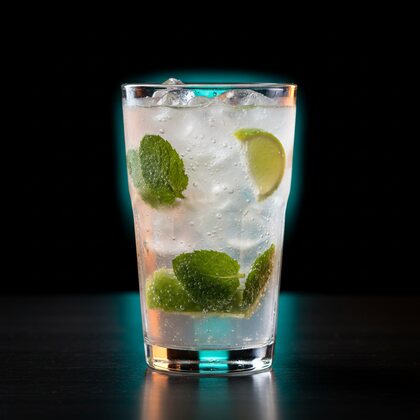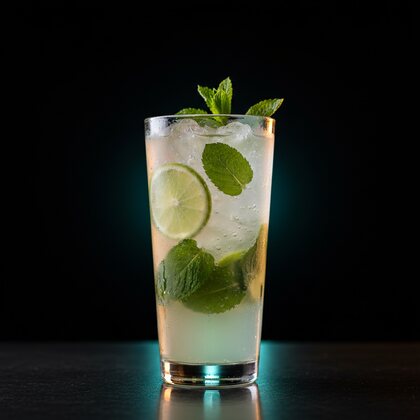
Virgin Mojito
Walk through a hotel bar on any evening and count who is not drinking alcohol: the guest who drives home later, the expectant mother at a birthday table, the family from the Gulf who never touch alcohol, the wellness traveller who did a 6 am run, the children at Sunday brunch. In a good hotel that is a third of the room, and every one of them deserves a glass built with the same care as a Daiquiri. The Virgin Mojito is where that care shows first, because it is the most ordered alcohol free drink in the world and the most often ruined. Take away the rum and there is nowhere to hide: bruised mint turns it bitter, bottled lime turns it flat, too much syrup turns it into lemonade. Done properly it is a tall glass packed with ice, cold enough to hurt your hand, cracked with lime, cool with spearmint, sweet only enough to carry the fruit, and topped with soda that is still hissing when it reaches the table.
Specification
| Ingredients | Amount | Role in the glass |
|---|---|---|
| Fresh spearmint leaves | 8 to 10 leaves, about 3 g, plus 1 sprig to garnish | The aroma and the cool sensation. Leaves only, no stems, picked the same day and kept in damp cloth in the fridge |
| Fresh lime juice | 25 ml, plus 2 lime wedges in the glass | The acid backbone. Without rum the lime has to carry the drink, so it must be squeezed within 4 hours |
| Cane sugar syrup 2:1 | 20 ml, roughly 12 g of sugar. Or 2 bar spoons of superfine cane sugar | Balances the acid. Cane sugar, not white refined, gives the faint molasses note the rum would have brought |
| Soda water | 120 to 150 ml, chilled to 2 to 4 °C | Length and sparkle. Cold soda holds its bubbles; warm soda goes flat inside a minute |
| Ice | Crushed or cracked ice to fill the glass, roughly 200 g | Rapid chilling and the controlled dilution that softens the lime. Also holds the mint suspended through the drink |
Technique
- Chill the highball. Fill it with ice while you prep, then tip the ice out just before buildingA warm glass melts the first 30 g of ice instantly, which is dilution you did not choose. Cold glass, cold soda, cold drink
- Drop 2 lime wedges into the glass and add the 20 ml syrup, then press the wedges 2 or 3 times with the muddlerPressing the peel releases lime oil, the bright aroma that bottled juice never has. The syrup gives the muddler something to work against so the fruit does not skid
- Place 8 to 10 mint leaves in your palm, clap once, then add them to the glass and press gently 3 to 4 times with the flat of the muddler, using no more force than you would to test whether bread is freshClapping ruptures the oil glands on the leaf surface and releases the aroma. Grinding or twisting tears the cell walls and pulls out chlorophyll and tannin, which is why a badly muddled Mojito tastes like lawn and turns brown within minutes
- Add the 25 ml lime juice and fill the glass three quarters with crushed ice, then churn with a bar spoon for 8 to 10 seconds, lifting from the bottomChurning distributes the mint and sugar through the ice column so the first sip and the last taste the same. Ten seconds also chills the base to around 0 °C before the soda goes in
- Top with 120 to 150 ml chilled soda, poured slowly down the bar spoon, cap with more crushed ice, then give one gentle lift with the spoonPouring down the spoon keeps the CO2 in the liquid instead of foaming it away. The soda must go in last and never be churned hard, or the drink arrives flat
- Slap a mint sprig against the back of your hand, set it in the ice beside the straw, and add a lime wheelThe guest's nose meets the sprig before the straw does, so the aroma is fresh mint rather than sugar. Placing it by the straw guarantees every sip passes through the scent
Service
Origin
Every Mojito, with or without rum, descends from Havana. The oldest story reaches back to the late 16th century and a drink called El Draque, named for the English privateer Francis Drake, or for his associate Richard Drake depending on who tells it: aguardiente, a rough cane spirit, mixed with lime, sugar and mint, taken as much as medicine against scurvy and dysentery as for pleasure. There is no hard document for that origin and a bar historian should call it what it is, a good legend. The paper trail starts much later. Recipes for the mixture appear in Cuban publications from 1927 under several names, and the word Mojito is printed on the souvenir menu of Sloppy Joe's Bar in Havana for 1931 to 1932, which is the earliest secure sighting of the name. The mint was, and in Cuba still is, hierbabuena, a local spearmint with a softer, less peppery leaf than the mint sold in most northern markets. The famous claim that La Bodeguita del Medio invented the drink, complete with Ernest Hemingway's handwritten line on the wall, my Mojito in La Bodeguita, my Daiquiri in El Floridita, is disputed. The bar only opened in the 1940s and took its name in 1950, and several Hemingway biographers regard the inscription as a promotional invention. The International Bartenders Association now lists the Mojito among its contemporary classics at 45 ml white rum, 20 ml lime juice, 6 mint sprigs, 2 teaspoons white cane sugar and a top of soda. The alcohol free version has no birthday. It grew up quietly in hotel bars, family restaurants and Gulf states through the 1990s and 2000s as the Mojito went global, and picked up the nickname nojito along the way. Today it outsells the original in many hotel lobbies.
Taste and body
The first thing you get is smell, cool spearmint and lime oil rising off the crushed ice. The sip is sharp lime up front, softened by cane sugar that shows a faint brown sugar note, then a clean prickle of soda. Mint sits underneath everything as a cooling sensation rather than a flavour, the way it does in a good tea. Light body, dry finish, and the glass should stay bright green and clear. If it is brown or tastes of grass, the mint was crushed too hard. If it is cloying, the syrup was poured by eye.
Pairs well with
- Grilled prawns or squid with chilli and lime
- Ceviche and other raw citrus cured fish
- Vietnamese fresh spring rolls with herbs
- Thai green papaya salad, the mint cools the chilli
- Club sandwich and other brunch and pool menu items
- Fresh fruit platters, especially pineapple, mango and watermelon
Hotel bar variations
- Nojito with apple or coconut water · Replace half the soda with 60 ml cloudy apple juice or chilled coconut water. Rounder and slightly sweeter, so drop the syrup to 10 ml. The version most often served to children
- Strawberry or passion fruit Virgin Mojito · Muddle 3 ripe strawberries or the pulp of 1 passion fruit with the lime before the mint. Cut the syrup to 10 ml because the fruit brings its own sugar. Strain nothing, the pulp is part of the look
- Ginger Virgin Mojito · Top with 120 ml chilled ginger beer instead of soda and add a thin slice of fresh ginger to the muddle. Spicy, warming and a clear step up in body. Use ginger beer, not ginger ale, for real heat
- Virgin Mojito Royale · Top with 100 ml well chilled alcohol free sparkling wine in place of soda. Drier and finer bubbles, the version for a wedding toast where the couple wants everyone holding a glass
- Mojito, the original · The parent drink: 45 ml white rum added after the lime and sugar, per the IBA spec. Everything in the technique above stays identical, which is why a bartender who makes a good Virgin Mojito makes a good Mojito
Common mistakes
- Grinding the mint. The leaves tear, chlorophyll and tannin leach out and the drink turns bitter and brown within 10 minutes. Press gently, 3 to 4 times, or just clap the leaves
- Bottled or pre squeezed lime juice from yesterday. Lime oxidises fast and turns flat and metallic. In an alcohol free drink there is no spirit to hide it
- Free pouring the syrup. Without rum the balance is only sugar against acid, and 5 ml too much syrup turns a Mojito into lemonade
- Warm soda, or soda poured hard into the glass. It loses its carbonation on the way in and the guest gets a still drink
- Mint stems and old leaves in the glass. Stems are bitter and black edged leaves look tired. Pick the leaves, store them in damp cloth in the fridge, and throw out anything that is wilted
Bartender's notes
Treat the Virgin Mojito as the flagship of the alcohol free list, not as a Mojito with something missing. Give it its own line on the menu with the same description length as the cocktails. When a guest declines alcohol, offer it by name rather than asking what soft drink they would like, because a named drink feels like hospitality and a soft drink feels like an afterthought. For pool and brunch volume, prepare a mint and lime base in advance: for 20 serves, 500 ml fresh lime juice, 400 ml 2:1 cane syrup and 200 g clapped mint leaves, steeped 20 minutes and then strained to remove the leaves. Store below 4 °C and use within 6 hours. Pour 45 ml of base per glass over crushed ice, add fresh mint and lime wedges for the look, top with soda. The guest still sees mint being slapped and lime being pressed, and you save 90 seconds per drink at a busy pass. Keep ginger beer and alcohol free sparkling wine in the fridge so the variations can be offered on the spot.
Let the AI bartender pick the right one for you
One photo. The AI reads your mood and chooses from all 20 classics.
Frequently asked questions
What is in a Virgin Mojito?
Fresh spearmint leaves, fresh lime juice and lime wedges, cane sugar syrup or superfine cane sugar, soda water and crushed ice, built in a highball glass. It is the classic Cuban Mojito with the white rum left out, and it contains no alcohol.
Does a Virgin Mojito contain any alcohol at all?
No. Every ingredient is alcohol free, so it is suitable for drivers, pregnant guests, children and guests who do not drink for religious reasons. If a bar tops it with alcohol free sparkling wine for a Royale version, check the label, as some products contain up to 0.5% ABV.
Why does my Virgin Mojito taste bitter or look brown?
The mint was muddled too hard. Tearing or grinding the leaves releases chlorophyll and tannin. Press gently 3 to 4 times, or simply clap the leaves between your palms to release the oils, and remove stems.
Can I use lemon lime soda instead of soda water?
You can, but then drop the syrup to 5 ml or none, because lemon lime soda already carries around 10 g of sugar per 100 ml. Plain soda water lets the lime and mint lead, which is the point of the drink.
What is a nojito?
Simply another name for the Virgin Mojito, a play on no and Mojito. Some bars use the name for versions topped with apple juice or coconut water instead of soda.
Which mint should I use?
Spearmint. In Cuba it is hierbabuena, a soft leaved local spearmint. Peppermint is too medicinal and overpowers the lime. Use young leaves without stems and keep them damp and cold until service.
Crushed ice or cubes?
Crushed or cracked ice. It chills the drink in seconds, holds the mint suspended through the glass and gives the classic frosted look. Large cubes leave the mint at the bottom and the top of the drink warm.
Can the Virgin Mojito be batched for events or pool service?
Yes. Make a base of fresh lime juice, cane syrup and clapped mint, steep 20 minutes and strain. Keep below 4 °C and use within 6 hours because the lime loses brightness. Pour over crushed ice with fresh mint and lime wedges, top with soda at the moment of service so it is never flat.